Is WordPress Really Dead? A Reality Check on Cloudflare Emdash
WordPress is dead, cooked, and basically a legacy platform, at least that’s what the internet is saying right now because of Emdash.
Emdash is a new Cloudflare product, essentially a CMS built using Astro. So let’s take a proper reality check, look at what this actually offers, and talk about how it stacks up against something like WordPress.
What is Emdash?
If you don’t know, the TLDR is this: on April 1st, Cloudflare introduced Emdash, calling it the “spiritual successor” to WordPress.
That alone has created a lot of hype. You’ve got Matt and Matt being involved, alongside the legacy of WordPress, so naturally the hype train is in full motion.
Now, it’s April 2nd as I’m looking at this, and unless time zones are playing tricks, this is actually a real product. That said, it’s very early, definitely a version one, likely more of a minimum viable product.
In this breakdown, I’ll show what’s included, highlight a few things that stand out, and then wrap up with how it compares to WordPress and whether it has a place in your workflow.
Getting Started with Emdash
You can either use the Emdash playground or deploy it to Cloudflare yourself. If you go the Cloudflare route, you’ll need R2 storage (not R2D2, unfortunately).
There may be some cost involved. You get up to 10GB of storage for free per month, but you still need to have a card on file.
For testing, the playground is the easiest option. Once you launch it, you’ll see a typical blog-style homepage. Posts are listed, you can click into them, and you get things like reading time, search, and a sidebar, pretty standard stuff.
The playground gives you about an hour before it resets, which is enough to explore.
Since it’s built on Astro, designing your own front end should be fairly straightforward if you’re already familiar with that ecosystem.
The Admin Experience
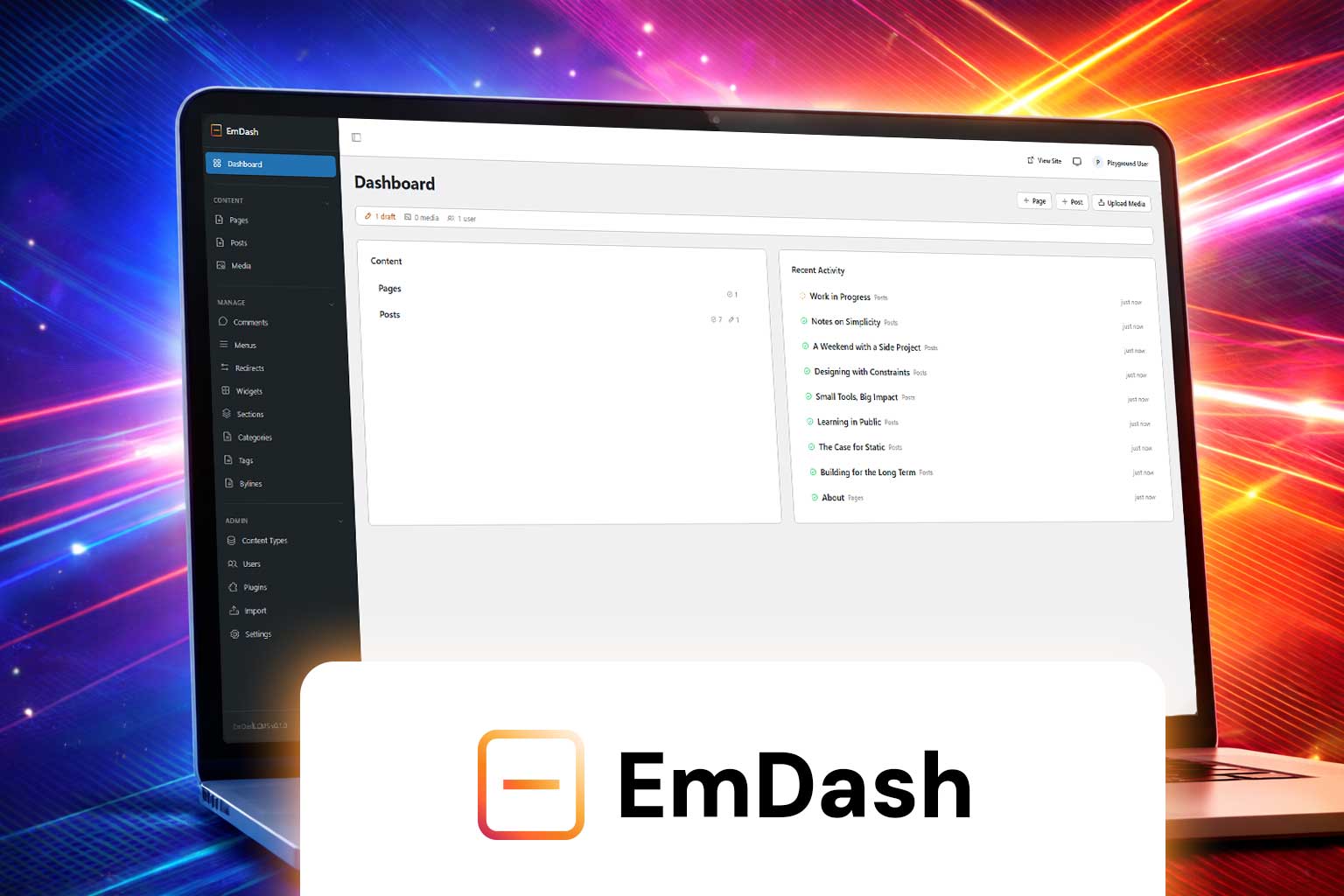
Once you log in, you’re greeted with something very familiar, a dashboard that looks a lot like WordPress.
Navigation is on the left, content overview in the main area. You can add posts, pages, upload media, and so on. Nothing surprising here.
Posts and Pages
Jump into posts, and again, it feels very “WordPress-like.” You can edit content, manage excerpts, slugs, status, authors, categories, tags, and more.
One thing you’ll notice straight away, no Gutenberg editor. For some, that’s a relief. For others, it might feel limiting.
But this is V1, so it’s important to keep expectations in check. It’s an MVP. Features may come later, but right now, it’s intentionally simple.
Built-in Features Worth Noting
SEO Included
SEO is built in by default. No need for third-party plugins like you would normally use in WordPress.
Plugin Approach (Security Focus)
One of the most interesting differences is how plugins are handled.
In WordPress, plugins can be a major security risk. In Emdash, plugins are compartmentalized. That means if one fails or has an issue, it shouldn’t affect the rest of your site.
That’s a big plus from a security standpoint.
Media, Comments, and Menus
The media library is very basic. You can upload and store files, but there’s no editing functionality.
Comments, menus, and navigation all work as you’d expect. You can create multiple menus and manage redirects directly inside the platform, which is a nice touch.
Widgets and Sections
Widgets feel like a throwback to older versions of WordPress, simple blocks you can drop into sidebars or footers.
You can add content blocks, edit them, move them around, it’s all very straightforward.
Sections allow you to create reusable content like author boxes or newsletter signups. Again, simple but functional.
Custom Content Types (A Nice Touch)
This is one of the more interesting features.
You can create custom content types, similar to custom post types in WordPress but in a more stripped-down way.
For example, you can create something like “Books,” then manually add fields like:
- Book title
- Description
- Cover image
Unlike WordPress, nothing is prebuilt, you define everything yourself. It’s simple, but it works.
Users and Security
User management is similar to WordPress, with roles like admin and the ability to invite users.
One standout feature is passkeys. This adds an extra layer of security by integrating with password management tools, reducing the risk of hacks.
Plugins and Extensibility
Plugins aren’t installed through a marketplace like WordPress.
Instead, you extend functionality through the astro.config.mjs file. This is more developer-focused and not as beginner-friendly.
Right now, it’s unclear how many plugins exist or how easy they are to use. That’s something that will become clearer over time.
Importing from WordPress
You can import content from a WordPress site using a URL or an XML export file.
That’s a smart move, making it easier for people to experiment without starting from scratch.
So… Is This Really a WordPress Successor?
Let’s be honest, no. Not right now.
And realistically, not anytime soon.
Could it take a tiny fraction of the market? Sure. Especially among developers who like experimenting with new tools.
But WordPress is deeply established. It has:
- A massive ecosystem
- Themes and plugins
- Page builders
- A huge developer community
That’s not something you replace overnight.
Where Emdash Could Fit
That said, Emdash does have some interesting advantages:
Built on Astro (fast, modern, clean)
Strong security approach
Tight integration with Cloudflare
Simpler, more controlled environment
If you don’t need all the flexibility of WordPress, this could be a nice lightweight alternative.
Final Thoughts
Calling it a “spiritual successor” is smart marketing. It creates hype, gets people talking, and brings attention to the product.
But in reality, this isn’t replacing WordPress. Not yet.
Still, it’s interesting. It’s cool to see new ideas, and it’ll be worth watching how this evolves, especially if Cloudflare expands it with more features or even a page builder experience.
What Do You Think?
Do you think this is a smart move by Cloudflare?
Or is it just hype with no real impact on WordPress?
Would love to hear your thoughts.